
Resilience, now.
Given the state of the work world and world at large, I wanted to share 10 perspectives that are available to you *right now* as tools to dust off and reclaim your resilience.

Today I gave a workshop "Resilience, now." at my alma mater, Tufts University -- and given the state of the work world and world at large, here are ten perspectives that are available to you *right now* as tools to dust off and reclaim your resilience.
1. You're already resilient -- the proof is in your past. Resilience isn't something you build from scratch. You've already demonstrated it. The work is about remembering and accessing what you already have.
2. Resilience has a literal definition worth revisiting: the ability of a substance or object to spring back into shape. It's elasticity. Not being tough or grinding through it. Coming back to form.
3. The absence of resilience has real consequences. Burnout, self-doubt, paralysis, spiraling. These are the effects of forgetting about your inner resilience, and naming them is the first step in changing them.
4. Remember why you work. It's rarely just the paycheck. When work feels like a trap, it's often because we've lost sight of what it's actually in service of. Reconnecting to your "why" is an act of resilience.
5. Do a stakes check. Most of the time, the stakes are lower than they feel. We respond to threats as if everything is on fire. Slowing down to actually assess the stakes (as honestly as possible) can bring resilience back into action fast.
6. Ask: is this happening, or happening to me? One of the quietest ways resilience leaks is when we make things personal that aren't. Clarifying that distinction helps to create space and room to breathe.
7. You can't control most things, and acknowledging that is freeing. You can control how you respond, what you focus on, and what you do next. That's about it -- and that's quite a lot.
8. Watch your "shoulds." "I should be further along." "I should be able to handle everything." The stories we tell ourselves are often the biggest source of resilience drain. Catching a "should" is a signal worth investigating.
9. Gratitude helps attitude -- it's neuroscience. Practicing gratitude increases serotonin and dopamine, which directly affect mood, willpower, and motivation. It trains the brain over time to focus on what's working, not just what isn't. Call it woo-woo, but it works.
10. Action is a one-way ticket to resilience. Understanding your situation is a valuable first step. But action is what closes the gap between where you are and where you want to be. There are all sizes of actions you can take -- right now -- like having a conversation, hiring an expert, revisiting and setting new boundaries, devising an experiment, making a commitment to yourself, investing a new tool to simplify something, etc.
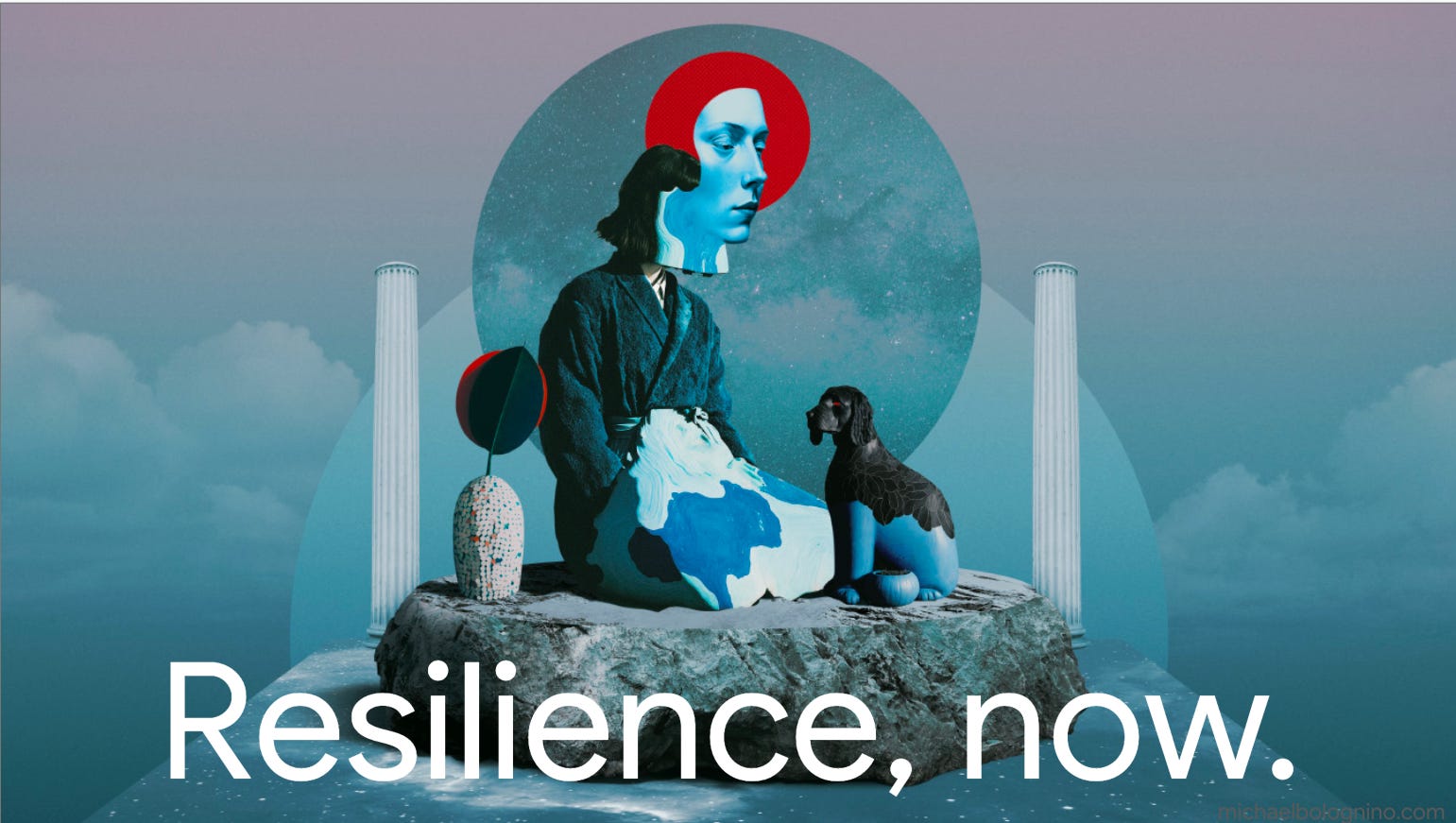
Image by Julien Pacaud
Love this! You always have such a thoughtful way at laying things out. Thanks for sharing and giving us something to ponder!